Loading course…
Developments in South and Southeast Asia from c. 1200 to c. 1450
Created by Shaunak Ghosh
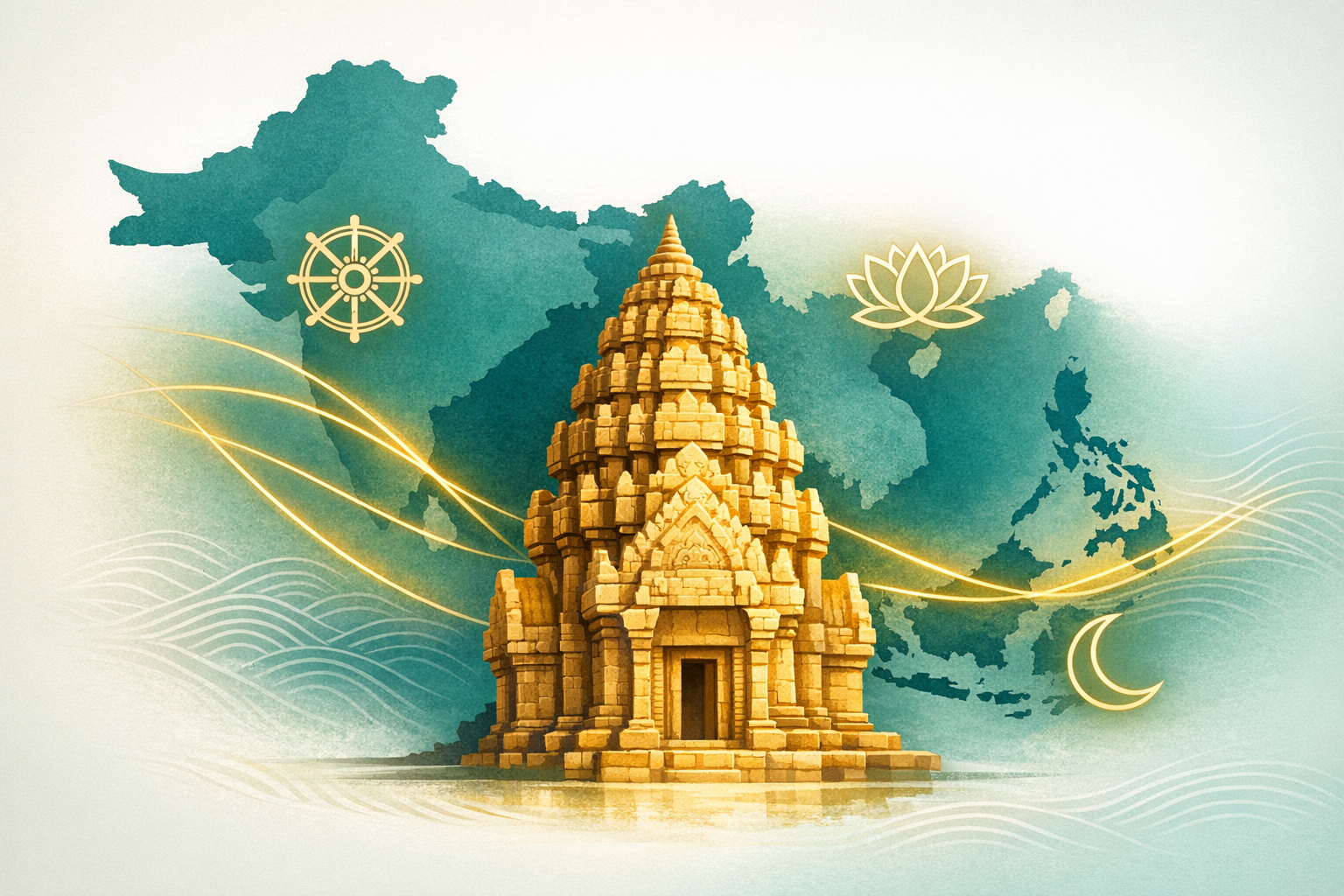
Explain how Hinduism, Buddhism, and Islam shaped societies and states in South and Southeast Asia from c. 1200–1450. You’ll connect trade networks to religious diffusion, then use concrete cases (Khmer/Angkor and Malacca) to argue how belief and legitimacy helped rulers build and maintain power—using AP-style reasoning language.
Requirements
- Basic map awareness of South Asia and Southeast Asia (India, Bay of Bengal, Malay Archipelago)
- Basic understanding of how trade routes connect regions and spread ideas
- Comfort with the idea that religions can shape social rules and political legitimacy
What you'll learn
- Explain how Indian Ocean networks enabled the diffusion of religions and institutions across South and Southeast Asia (c. 1200–1450).
- Describe and compare key Hindu and Buddhist beliefs and explain how they shaped social expectations and community life.
- Explain how Islam spread through trade and religious networks and why conversion often occurred gradually alongside pluralism.
Learning path
8 modules • Each builds on the previous one
1
Regional networks in South and Southeast Asia
Build the geographic and network context for c.1200–1450: Indian Ocean trade, overland connections, port cities, and how networks transmit ideas and institutions. This sets up why belief systems could spread and reshape societies and states.
1 video5 min
2
Hinduism beliefs, practices, and social effects
Explain Hindu core ideas (dharma, karma, samsara, moksha), major traditions (bhakti), and how practices (temple patronage, pilgrimage, ritual) shaped social structures and legitimacy in South and parts of Southeast Asia.
1 video5 min
3
Buddhism in South and Southeast Asian societies
Cover Buddhist core ideas and institutions with emphasis on the period’s dominant Southeast Asian forms (Theravada) and how monasteries, merit-making, and kingship patronage shaped communities and political authority.
1 video7 min
4
Islam’s spread and social change in Asia
Explain how Islam expanded into South and Southeast Asia via conquest, trade, and Sufi networks, and how Islamic law, scholarship, and community structures reshaped societies while also blending with local cultures.
2 videos6 min
5
Syncretism and pluralism across Asian belief systems
Synthesize how Hinduism, Buddhism, and Islam interacted in South and Southeast Asia through syncretism, layered religious practice, and state tolerance/intolerance. Emphasize how diffusion creates hybrid culture rather than simple replacement.
1 video6 min
6
Hindu and Buddhist states: power and legitimacy
Explain how new Hindu and Buddhist states in South and Southeast Asia used religion to build legitimacy, integrate populations, and organize resources—showing continuity, innovation, and diversity (e.g., temple complexes, divine kingship, administrative patronage).
1 video9 min
7
Islamic and maritime states: continuity and innovation
Explain how states other than Hindu/Buddhist—especially Islamic states in South and Southeast Asia—formed and maintained power, balancing imported Islamic institutions with local political realities (Delhi Sultanate; Malacca and other sultanates).
1 video6 min
8
AP World reasoning: C/C/D and SAQs
Practice explaining how belief systems shaped societies and how states formed/maintained power using AP reasoning moves: continuity/change, comparison, and the continuity/innovation/diversity lens, supported by specific evidence from c.1200–1450 South and Southeast Asia.
1 video4 min
Start Learning
Begin your learning journey
Modules8
Duration43 min
Science-backed learning
In-video quizzes and scaffolded content to maximize retention.
Key concepts
Indian Ocean Trade Networks And Chokepoints (Malacca Strait)Diffusion Model: Carriers, Nodes, And IncentivesHindu Core Concepts (Dharma, Karma, Moksha) And Social Hierarchy (Caste)