Loading course…
Test Your Code Before PRs
Created by Shaunak Ghosh
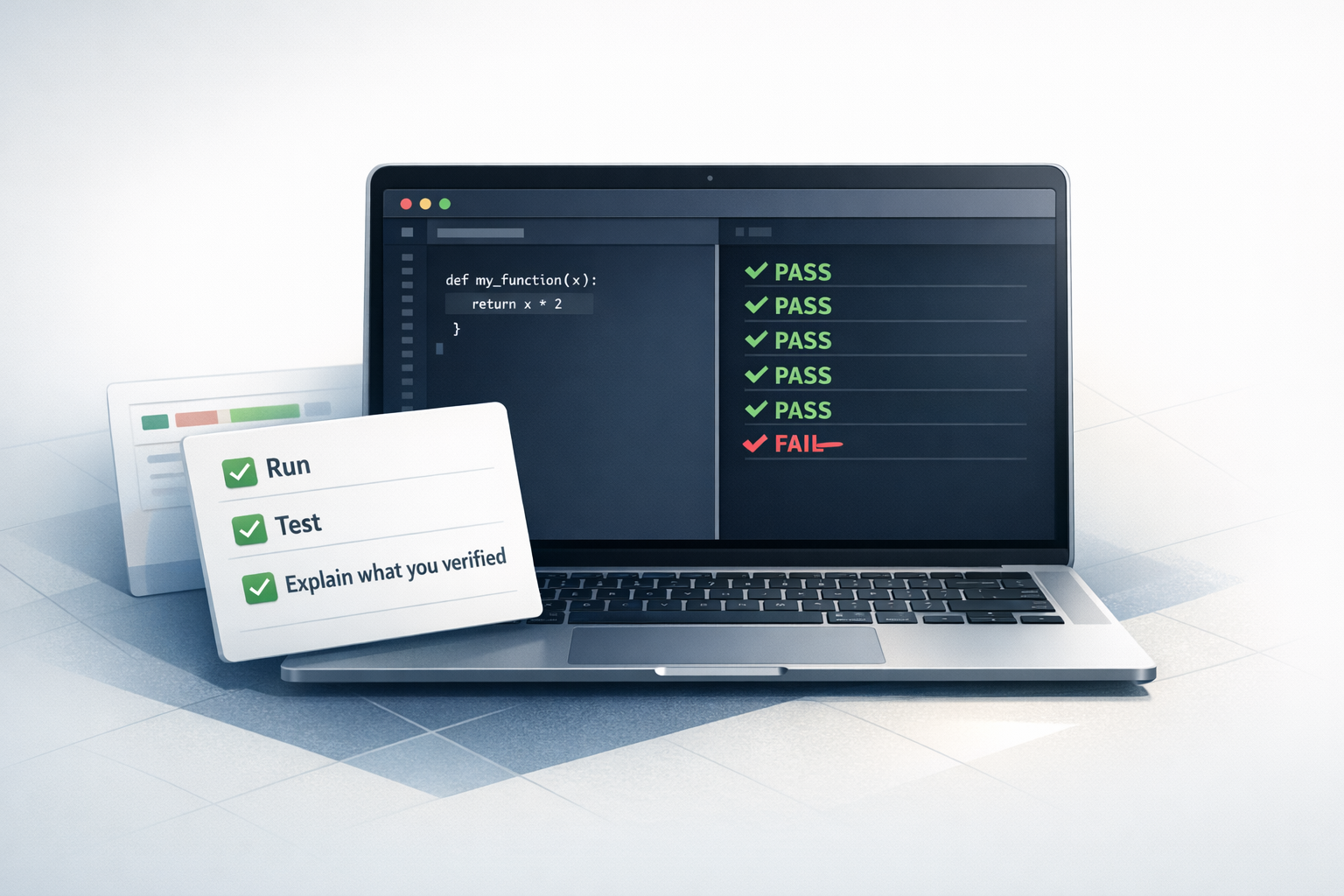
Interns will learn a practical routine to prove their change works before opening a pull request: targeted manual scenarios, a small set of reliable unit tests, and confidence-building evidence for reviewers. You’ll practice how to test happy paths, edge cases, and error conditions—and how to decide what’s worth testing vs. what’s safe to skip.
Requirements
- Basic ability to run a project locally (build/run command or IDE run button)
- Comfort with Git basics (commit, branch, push) and opening PRs
- Basic programming literacy (functions, inputs/outputs, reading error messages)
What you'll learn
- Define what “done” means before opening a PR and run a repeatable local checklist (automated checks + targeted manual verification).
- Generate a small, high-value set of manual test scenarios from a ticket and add brief exploratory testing to catch surprises.
- Write and run basic unit tests locally, including tests that assert exceptions for error conditions.
Learning path
5 modules • Each builds on the previous one
1
Pre-PR “done” checklist mindset
Define what “done” means before opening a PR: code runs, basic quality gates pass, and you can explain what you verified. Build a short, repeatable checklist interns can run every time to increase confidence and reduce review churn.
1 video6 min
2
Manual testing scenarios to run
Learn how to choose manual test scenarios quickly and systematically: happy path, common user flows, regressions, and “what changed” focus. Use a simple scenario matrix to avoid missing obvious breakages.
2 videos8 min
3
Write basic unit tests for functions
Write small, fast unit tests for a single function: Arrange–Act–Assert, clear naming, deterministic inputs/outputs, and testing one behavior per test. Focus on testing business logic, not wiring.
1 video3 min
4
Use your language test framework
Learn the minimum you need to be productive in a test framework: how tests are discovered, how to run a single test vs all tests, common assertions, and reading failures. Map the ideas to popular frameworks in your language.
1 video7 min
5
Edge cases, errors, and skip rules
Decide what should be tested (high-risk logic, boundaries, error handling) vs what can be skipped (thin wrappers, trivial getters, well-tested libraries). Practice adding edge/error tests and knowing when you’ve tested enough to open a PR confidently.
2 videos8 min
Start Learning
Begin your learning journey
Modules5
Duration29 min
Science-backed learning
In-video quizzes and scaffolded content to maximize retention.
Key concepts
Pre-PR Definition Of “Done” And Confidence ChecklistAutomating Local Quality Gates (Pre-Commit Hooks)Deriving Manual Test Scenarios From Requirements/User Stories