Loading course…
Build Backends from Reusable Modules
Created by Petter Smit
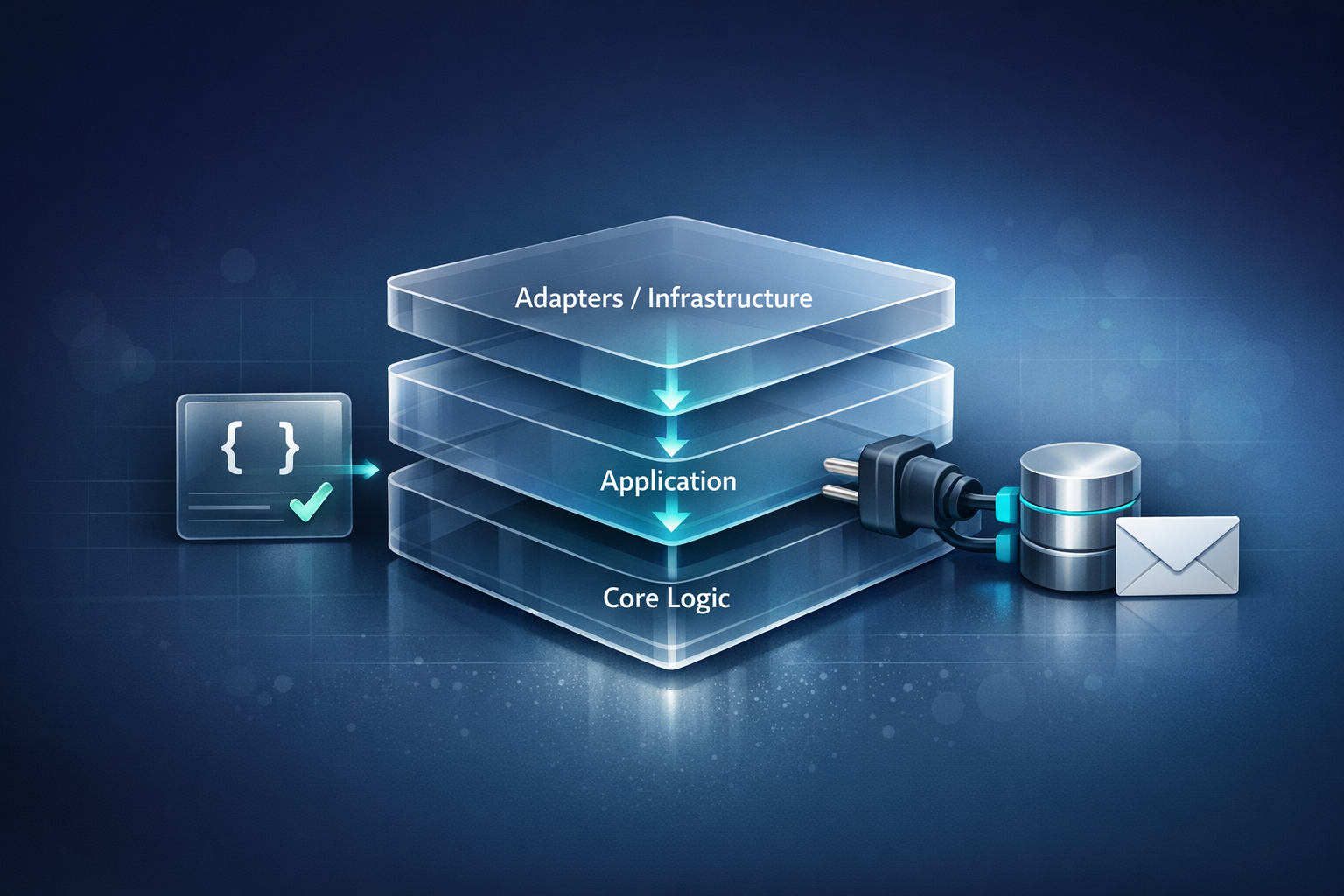
Design backends that stay modular as they grow: clear layers, stable interfaces, and dependency direction that keeps changes local. You’ll practice applying ports/adapters and dependency injection, making data access swappable, defining API contracts with validation, and choosing tests that protect reuse—then packaging modules for reuse across projects.
Requirements
- Comfort writing backend code with functions/classes and modules/packages
- Familiarity with unit tests at a basic level (assertions, test doubles/mocks as a concept)
- Basic understanding of HTTP APIs (requests/responses, status codes)
- Practical experience refactoring code (extracting functions/modules, renaming, moving responsibilities)
What you'll learn
- Draft a backend module map with clear layer responsibilities and one-way dependency rules
- Design stable module interfaces that hide complexity without becoming leaky abstractions
- Apply ports/adapters plus dependency injection to swap infrastructure without rewriting core logic
Learning path
8 modules • Each builds on the previous one
1
Backend boundaries, layers, and modules
Learn how to slice a backend into modules by responsibility (domain logic, application services, infrastructure, delivery/API) so changes stay local and reuse stays realistic.
1 video7 min
2
Stable interfaces for reusable backend modules
Design module APIs (function/class interfaces) that stay stable while implementations change—using explicit contracts, narrow interfaces, and clear input/output models.
1 video6 min
3
Dependency inversion with ports and adapters
Apply Dependency Inversion Principle (DIP) so business logic depends on abstractions (ports), while infrastructure (databases, email, queues) plugs in via adapters.
1 video6 min
4
Dependency injection for modular backends
Use dependency injection (constructor injection, factories, lightweight DI patterns) to wire modules together without hard-coding implementations—making code reusable and testable.
1 video5 min
5
Reusable data access with repository pattern
Decouple domain/application logic from persistence by using repositories (and optionally Unit of Work) so you can swap databases, ORMs, or storage strategies without rewriting core code.
1 video8 min
6
API contracts, validation, and versioning
Design backend APIs as stable contracts using schemas (OpenAPI/JSON Schema), input validation, and versioning strategies so clients and internal modules can evolve safely.
2 videos12 min
7
Testing modular backends for reuse
Build confidence in reuse with a testing pyramid: fast unit tests for core logic, integration tests for adapters, and contract tests for APIs and ports.
2 videos13 min
8
Packaging reusable backend modules and libraries
Turn internal modules into reusable packages (shared libraries or internal packages), with semantic versioning, changelogs, and minimal public APIs so multiple projects can safely depend on them.
1 video6 min
Start Learning
Begin your learning journey
Modules8
Duration59 min
Science-backed learning
In-video quizzes and scaffolded content to maximize retention.
Key concepts
Backend Layering And Dependency DirectionDesigning Stable Abstractions And Avoiding Leaky InterfacesPorts And Adapters (Hexagonal) For Reusable Core Logic