Loading course…
Deciding If Alpha Fits Your Child
Created by Shaunak Ghosh
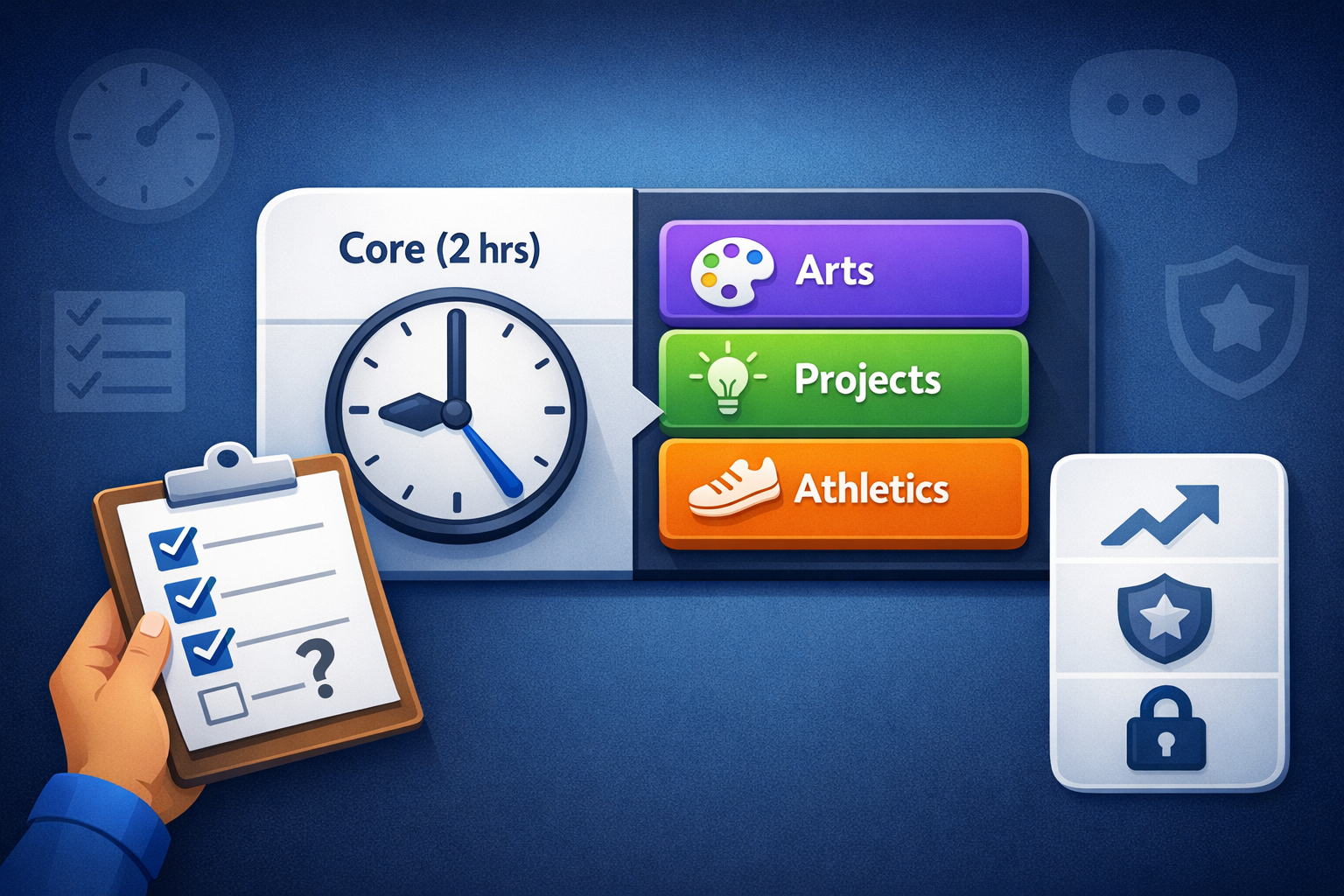
Build a complete, parent-ready understanding of Alpha Schools and the “2-hour learning” claim—from daily operations and mastery pacing to data privacy, supports, and culture. You’ll learn what evidence to request, what tradeoffs to expect, and how to make a structured fit decision grounded in artifacts, not marketing.
Requirements
- Comfort asking detailed questions in a school meeting
- Basic understanding of how a typical school day is structured (classes, teachers, schedules)
- Willingness to review documents like handbooks, policies, and assessment reports
What you'll learn
- Explain the Alpha-like model in plain terms and distinguish marketing claims from operational realities.
- Precisely interpret the “2-hour learning” claim and identify the conditions required for it to be credible.
- Evaluate mastery-based pacing (thresholds, reassessment, gap management) and anticipate common failure modes.
Learning path
13 modules • Each builds on the previous one
1
Alpha Schools model in plain terms
Define what “Alpha Schools” typically means in practice (mastery-based academics, compressed core instruction, and expanded enrichment) and clarify common variations across campuses or operators. Establish shared vocabulary so parents can evaluate details rather than slogans.
2 videos5 min
2
What “2-hour learning” actually means
Unpack the “2-hour learning” claim: what is included/excluded (core academics vs. total school day), typical subject allocation, and how time compression is achieved (diagnostics, adaptive practice, mastery checkpoints).
3 videos8 min
3
Mastery-based learning and pacing rules
Explain mastery-based progression: competency definitions, mastery thresholds, retake/redo policies, pacing expectations, and how schools prevent gaps. Address edge cases like “fast but fragile” learning and slow-but-steady learners.
3 videos8 min
4
Adaptive software, data, and feedback loops
Describe how adaptive learning tools typically function (placement diagnostics, item-level difficulty, spaced practice) and how staff should use data (interventions, grouping, goal-setting). Include privacy, screen-time quality, and algorithm limitations as critical evaluation points.
3 videos11 min
5
Role of guides, teachers, and coaching
Clarify staffing models often used in Alpha-like schools: guides/coaches vs. subject teachers, small-group instruction, conferencing, and behavior/culture leadership. Address what high-quality coaching looks like and how to spot under-supported classrooms.
3 videos9 min
6
Curriculum, rigor, and standards alignment
Evaluate what students learn: curriculum sources, knowledge-building vs. skill drills, writing expectations, science labs, and how alignment to standards or college expectations is maintained. Include the difference between “coverage” and “mastery of essentials.”
2 videos10 min
7
Daily schedule: academics and enrichment blocks
Map the full day: core academic block(s), independent practice, small-group lessons, enrichment/PE/arts, clubs, and outdoor time. Address logistics: transitions, supervision, behavior systems, and how enrichment quality is ensured (not just “free time”).
3 videos7 min
8
Motivation, independence, and self-directed habits
Analyze how the model builds (or fails to build) self-regulation: goal-setting, focus, persistence, help-seeking, and reflection. Include edge cases: perfectionism, low intrinsic motivation, attention challenges, and compliance without learning.
3 videos11 min
9
Assessment, grades, and transcript credibility
Explain how progress is measured: diagnostic placement, mastery checks, norm-referenced tests, writing samples, projects, and external benchmarks. Cover transcripts/credits (especially for middle/high school), grade equivalency claims, and how to validate growth responsibly.
3 videos8 min
10
Socialization, culture, and student wellbeing
Evaluate peer dynamics, belonging, discipline approaches, and emotional safety in a model with significant independent work. Address common parent concerns: friendships, collaboration, conflict resolution, bullying prevention, and stress/anxiety patterns.
4 videos10 min
11
Support for learning differences and needs
Examine how Alpha-like schools handle IEP/504 accommodations, dyslexia, ADHD, autism, anxiety, giftedness, and multilingual learners. Focus on staffing, intervention tiers, specialized services, and the limits of “personalization” without specialists.
3 videos7 min
12
Cost, admissions, logistics, and policies
Cover tuition/fees, scholarships, transportation, aftercare, devices, uniforms, calendar, and policies (homework, behavior, screen time, parent communication). Include contract nuances: withdrawals, re-enrollment, and midyear transitions.
4 videos10 min
13
Evidence, tradeoffs, and fit decision framework
Synthesize benefits, risks, and uncertainties: who thrives, who struggles, and what signals predict outcomes. Provide a structured decision framework (criteria weighting, must-haves vs. nice-to-haves), plus a high-leverage question set and red flags for visits and interviews.
4 videos11 min
Start Learning
Begin your learning journey
Modules13
Duration111 min
Science-backed learning
In-video quizzes and scaffolded content to maximize retention.
Key concepts
Alpha-Like School Model And Key VocabularyMeaning And Assumptions Behind “2-Hour Learning”Mastery-Based Progression And Pacing Tradeoffs