Loading course…
Writing Reliable Skill Files for Agents
Created by Shaunak Ghosh
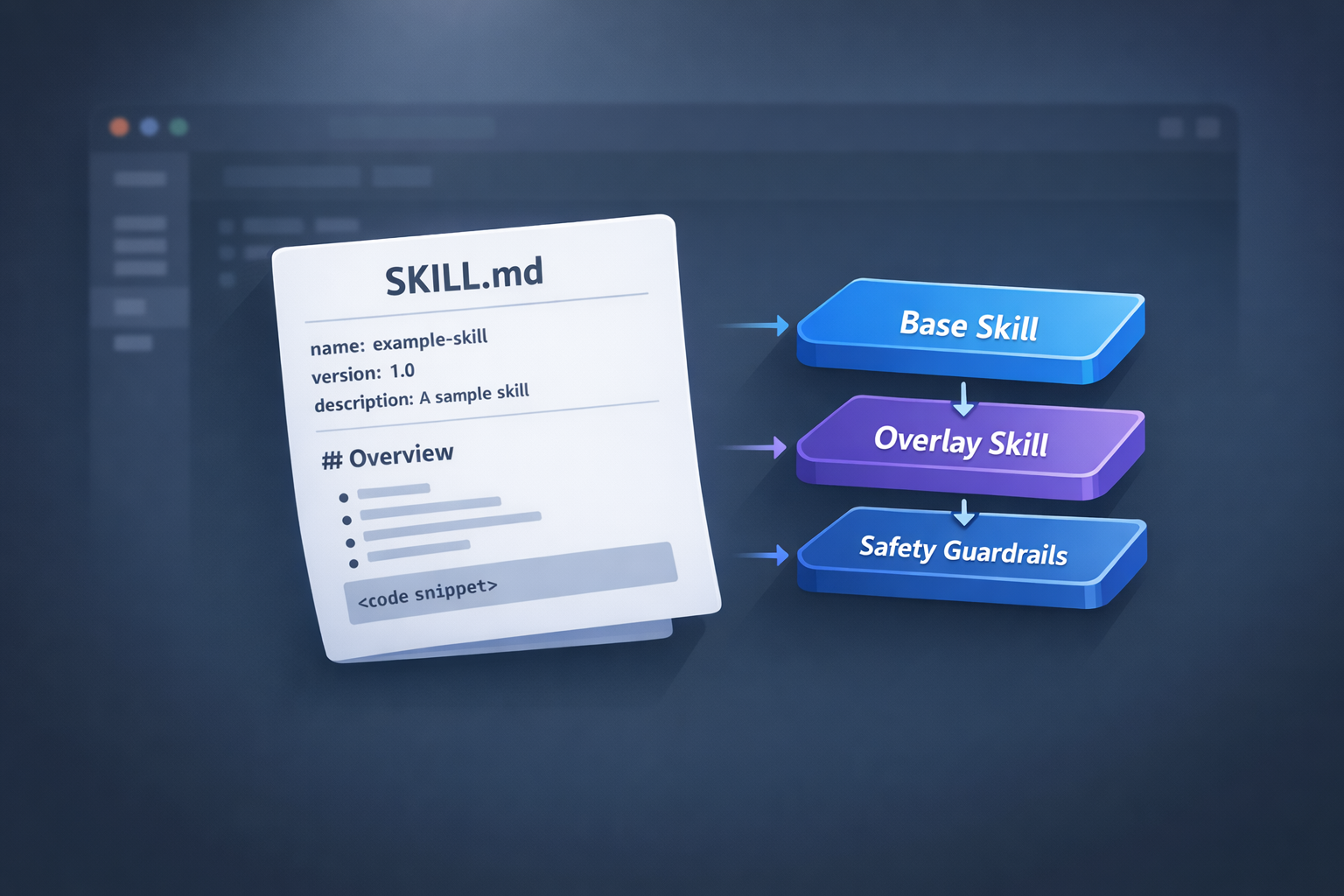
Design, write, and ship production-grade SKILL.md files that make coding agents more consistent, composable, and safer. You’ll learn how Markdown structure and explicit contracts drive behavior, then apply orchestration, integration, testing-style validation, and security hardening to build a reusable skill library.
Requirements
- Comfortable prompting LLMs for coding workflows
- Working knowledge of Markdown (headings, lists, code blocks)
- Ability to write clear requirements and acceptance criteria
- Basic familiarity with Cursor or Claude-style agents
What you'll learn
- Explain what an agent skill is, how it is discovered/loaded, and when it beats a one-off prompt.
- Use Markdown structure, output contracts, and few-shot exemplars to reduce variance and enforce repeatable behavior.
- Author a portable SKILL.md skeleton with explicit scope, constraints, and validation signals.
Learning path
7 modules • Each builds on the previous one
1
Agent skills: purpose and mechanics
Define agent skills and how skill.md context changes agent behavior. Map the mechanics: instruction hierarchy, routing/activation assumptions, and how skills increase consistency and capability.
1 video7 min
2
How LLMs read Markdown context
Learn how headings, lists, code blocks, and examples influence model behavior. Cover chunking/attention, instruction salience, and why formatting consistency matters for skills.
1 video5 min
3
Skill.md anatomy: metadata to constraints
Break down a production skill.md file into stable sections: metadata, scope, instructions, examples, constraints/guardrails, and output contracts. Emphasize portability and clarity across systems.
1 video5 min
4
Writing principles: clarity and edge cases
Apply professional writing principles for skill.md: unambiguous verbs, scoped rules, decision tables, edge-case handling, and fail-closed defaults. Emphasize maintainability and conflict resolution.
1 video5 min
5
Ralph Wiggum method simplification patterns
Use simplification techniques to make skills robust: reduce degrees of freedom, constrain vocabulary/outputs, move complexity into examples, and prefer small explicit steps over broad goals.
1 video4 min
6
Open prose orchestration and composition
Design multi-skill systems using open prose orchestration: routing language, role handoffs, tool-use policies, and composition patterns (base skill + specialized overlays). Manage conflicts and precedence explicitly.
2 videos10 min
7
Integration, testing, and safety hardening
Operationalize skills: integrate into Cursor, Claude, and custom agents; create a lightweight eval harness (fixtures, assertions, regression). Add safety controls: refusal rules, sensitive-data handling, and jailbreak resistance.
3 videos13 min
Start Learning
Begin your learning journey
Modules7
Duration45 min
Science-backed learning
In-video quizzes and scaffolded content to maximize retention.
Key concepts
Agent Skills Mechanics And Metadata-Driven ActivationMarkdown Structuring For Instruction Salience And ConsistencySKILL.Md File Anatomy And Output Contracts