Loading course…
Reasoning Patterns for Reliable AI Agents
Created by Petter Smit
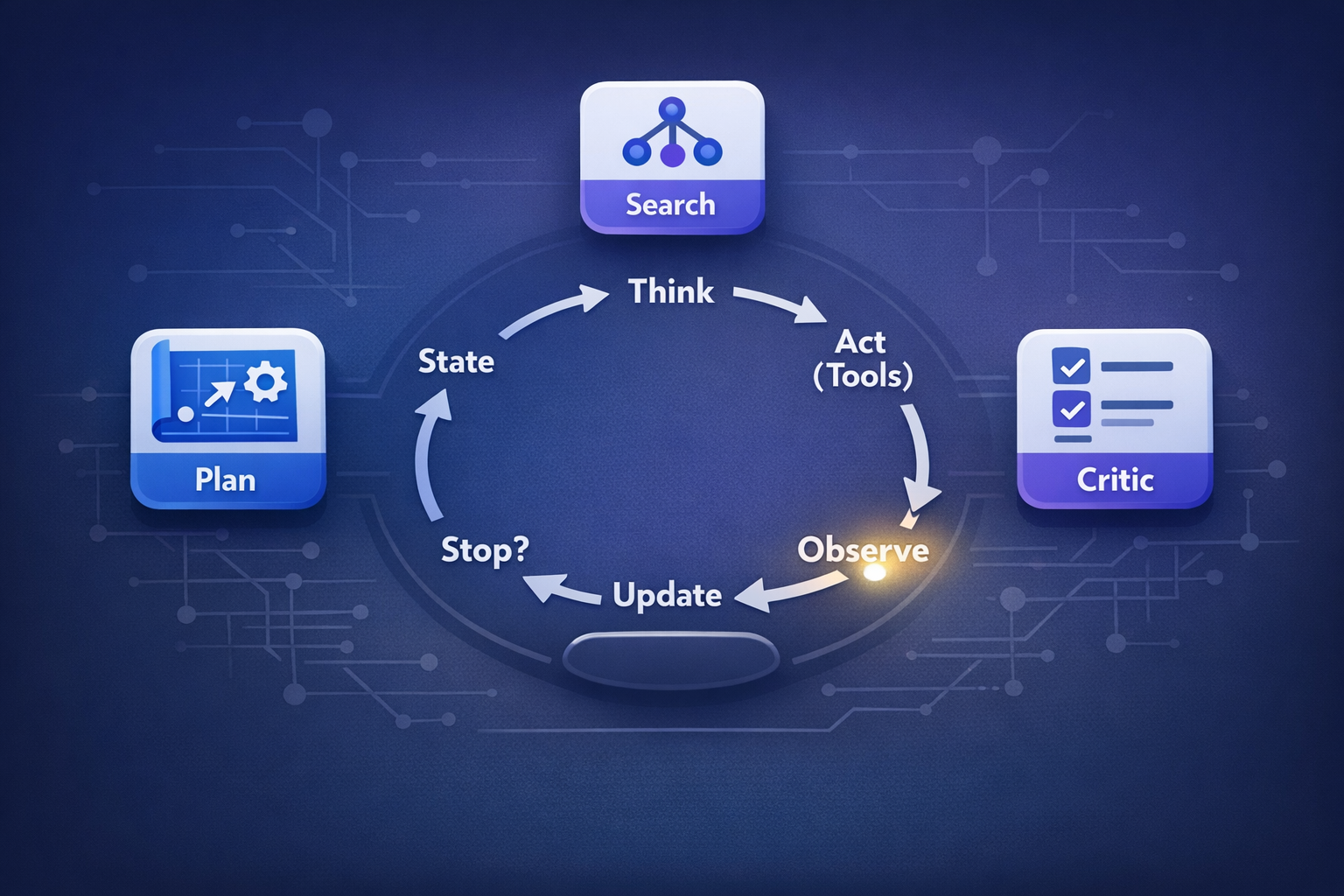
You will map and implement the core reasoning engine patterns used in modern AI agents, from ReAct control loops to planning, branching search, and evaluator-driven self-correction. By the end, you can choose the right reasoning pattern for a task, wire it into an agent loop with termination gates, and manage long-horizon memory with summarization and scaffolding tradeoffs.
Requirements
- Comfort with LLM chat/completions and tool/function calling
- Basic control-flow concepts (loops, conditions, state)
- Familiarity with structured outputs (e.g., JSON schemas)
- Awareness of context windows and token budgeting
What you'll learn
- Draw and explain a minimal agent reasoning loop, including state, tool actions, observations, and termination criteria.
- Decide what belongs in prompts versus orchestrator-level context assembly, and apply constraints to reduce guesswork.
- Implement and debug a ReAct-style tool loop, including robust observation schemas and stop conditions that prevent infinite loops.
Learning path
7 modules • Each builds on the previous one
1
Agent reasoning engine primitives
Define the reasoning engine as a control loop over state, tools, and memory, and map where prompting patterns fit (policy, planner, critic, summarizer) versus what belongs in the orchestrator.
2 videos9 min
2
ReAct loop control and termination
Implement ReAct as a tight Thought→Action→Observation loop with explicit state updates, error handling, and termination criteria; focus on correctly feeding observations back into the next step.
2 videos13 min
3
Chain-of-Thought use in production
Use CoT as a reasoning scaffold while managing exposure: structured intermediate steps, hidden reasoning patterns, and testable decomposition without leaking sensitive traces.
2 videos10 min
4
Plan-and-Solve prompting for agents
Separate planning from execution: generate an explicit roadmap (subgoals, tool plan, checks) before solving, then execute with verification and replanning triggers.
1 video6 min
5
Tree of Thoughts search and pruning
Move from linear CoT to explicit search: generate multiple candidate thoughts, score them with evaluators/lookahead, then prune/expand under a token/latency budget.
1 video4 min
6
Self-reflection and self-criticism loops
Add evaluator passes to detect mistakes and constraint violations: reflection for strategy correction, criticism with explicit rubrics (functional, security, style, policy) and multi-criteria scoring.
2 videos7 min
7
Recursive summarization for long agents
Use hierarchical/rolling summaries to keep long-horizon agents coherent: compress history into stable abstractions, preserve constraints/rubrics, and prevent goal drift under context limits.
2 videos12 min
Start Learning
Begin your learning journey
Modules7
Duration57 min
Science-backed learning
In-video quizzes and scaffolded content to maximize retention.
Key concepts
Reasoning Engine As An Agent Control Loop (State, Tools, Memory)Prompt Vs Context Engineering In Agent SystemsReAct Loop Design, Observation Injection, And Termination Gates