Loading course…
Production-Ready Agent Execution and Tooling
Created by Petter Smit
Design and operate the execution layer of agentic systems: robust tool contracts, deterministic executor loops, and safe code execution via sandboxes. You will integrate modern execution infrastructure (E2B) and standardize tool connectivity with MCP, then add resumable HITL gates and deterministic guardrails for high-impact actions.
Requirements
- Tool/function calling fundamentals (schemas and tool messages)
- Comfort implementing API-driven execution loops
- Basic security intuition for secrets, isolation, and least privilege
- Familiarity with agent loops (plan/act/observe)
What you'll learn
- Design tool interfaces with explicit contracts, safe result envelopes, and clear redaction boundaries.
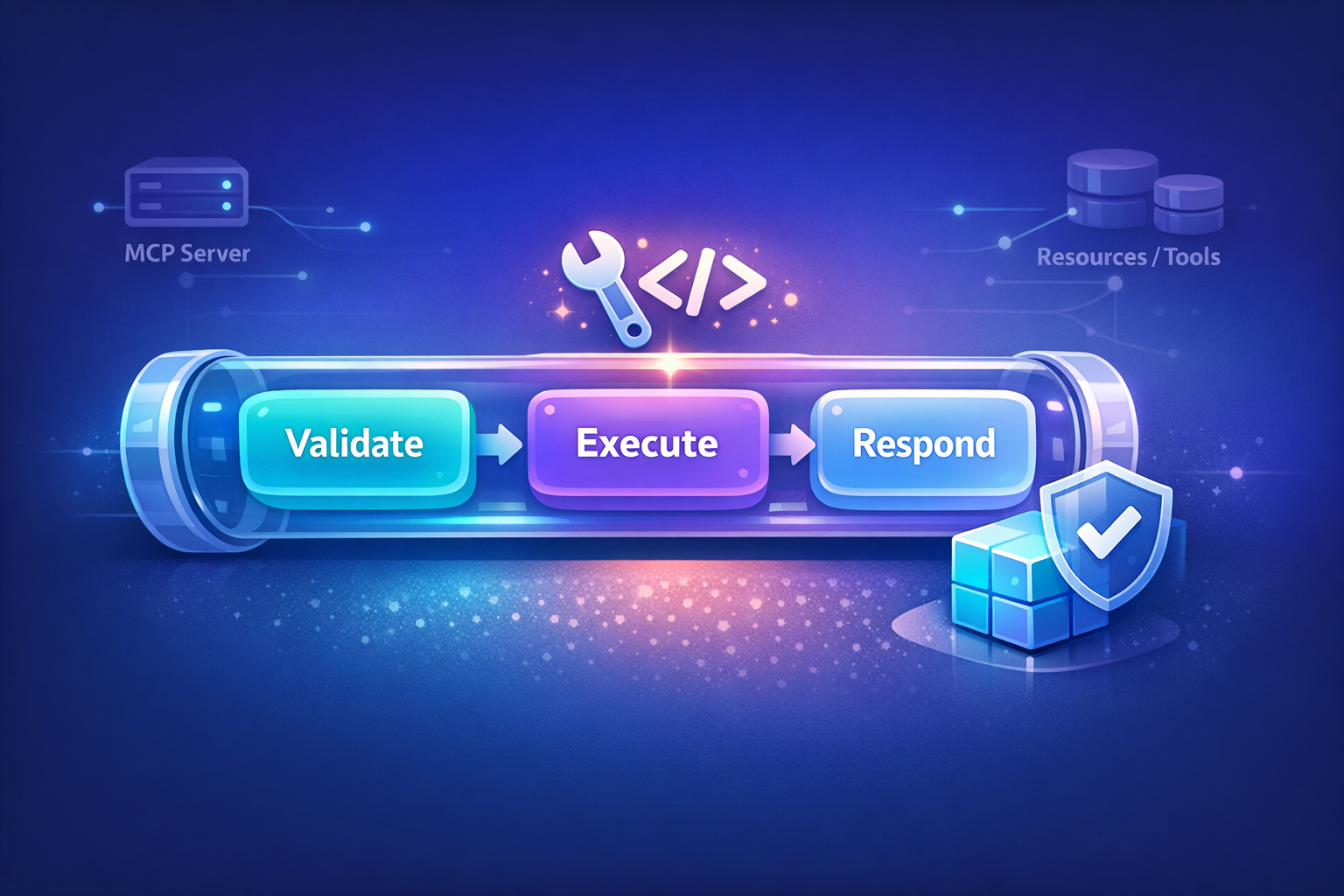
- Implement a production executor loop that validates inputs, executes tools, and returns actionable errors for model self-correction.
- Orchestrate code execution tools to produce deterministic artifacts, with inspectable outputs and traceability.
Learning path
7 modules • Each builds on the previous one
1
Tool calling contracts and result envelopes
Define the runtime “contract” between model and executor: tool signatures, typed arguments, tool result envelopes, and how errors/partial results are returned to the model without leaking secrets.
2 videos9 min
2
Function execution pipeline: validate, execute, retry
Engineer the executor loop: strict argument validation, deterministic parsing, retry strategy, idempotency keys, timeouts, and safe error feedback to the model for regeneration.
2 videos12 min
3
Code interpreter tool orchestration patterns
Use a code interpreter as a tool safely: plan→write→run→inspect loops, artifact handling (files/plots), dependency constraints, and translating execution outputs back into model-usable signals.
2 videos8 min
4
Sandbox threat model: prevent data exfiltration
Understand what sandboxing is actually for in agent execution: isolating untrusted code from host filesystem, network, metadata services, and secrets; define least-privilege policies and deny-by-default networking.
1 video5 min
5
E2B sandboxed execution: micro-VM workflows
Apply sandboxing via E2B-style environments: ephemeral micro-VM sessions, lifecycle management, filesystem mounts, controlled networking, streaming logs, and returning artifacts safely to the agent/UI (execution-to-browser).
2 videos10 min
6
MCP integration: tools, resources, auth
Use MCP to standardize connecting models to tools and data: MCP server design, resource vs tool modeling, authN/Z, capability scoping, and safe context shaping to prevent overexposure.
2 videos9 min
7
HITL approvals and deterministic guardrails
Combine Human-in-the-loop gates with deterministic controls: policy-as-code checks, schema/regex/rule validation, allowlists, permissioning, audit logs, and resumable approval workflows for high-impact tools.
2 videos10 min
Start Learning
Begin your learning journey
Modules7
Duration59 min
Science-backed learning
In-video quizzes and scaffolded content to maximize retention.
Key concepts
Tool Contracts, Schemas, And Result EnvelopesSecret Redaction And Model-Visible BoundariesExecutor Loops: Validation, Execution, And Error Feedback