Loading course…
System Design Mastery - 5 Essential Patterns for FAANG Interviews
Created by Shaunak Ghosh
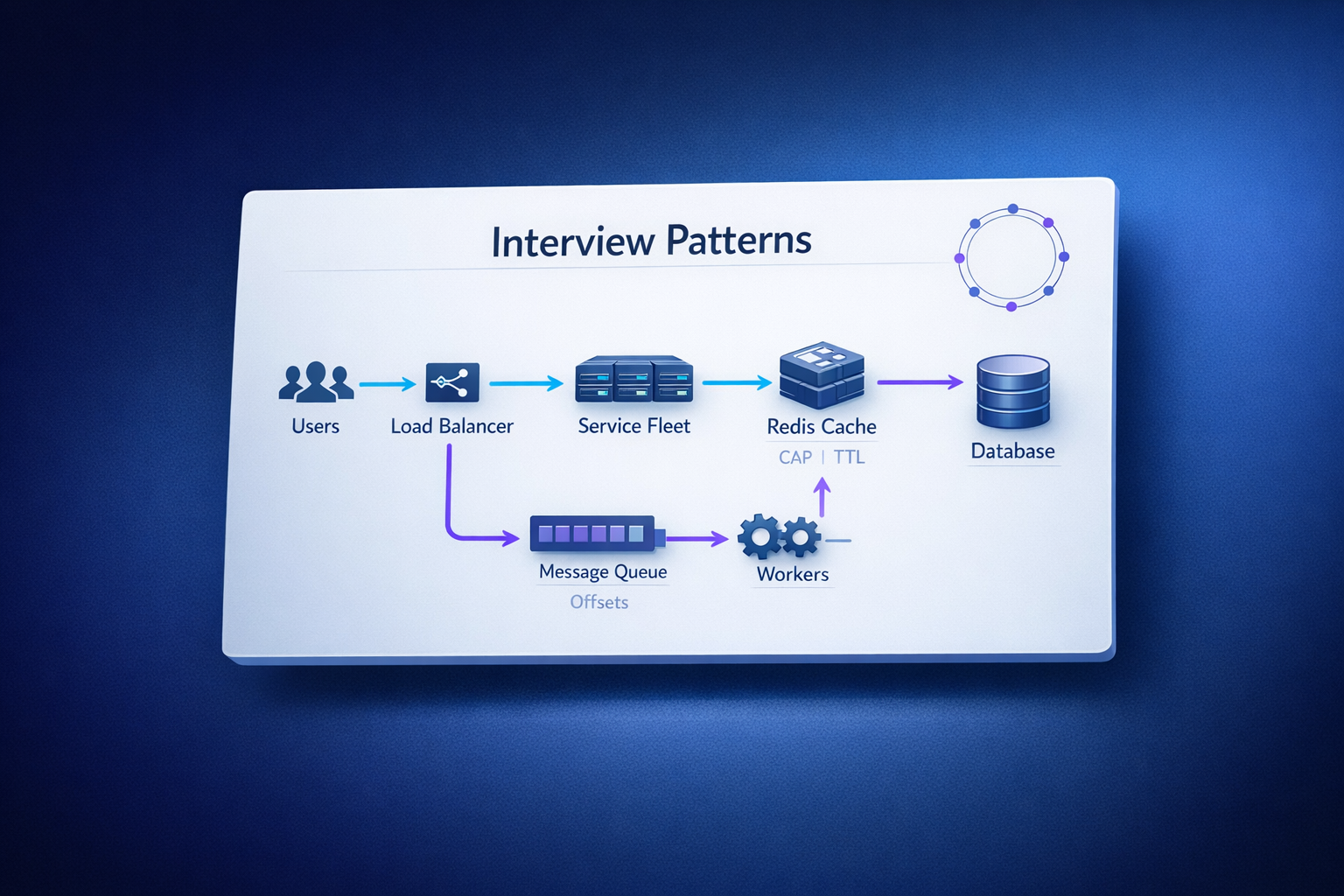
Build a repeatable, interview-ready system design toolbox the way Gaurav Sen typically frames it: start from requirements, find bottlenecks, then pick primitives and justify tradeoffs. You’ll practice crisp explanations for load balancing, CAP-driven consistency choices, Redis caching patterns at scale, consistent hashing, and async processing with queue delivery semantics.
Requirements
- Comfort with client–server HTTP APIs and basic networking
- Basic understanding of latency vs throughput and bottlenecks
- Familiarity with databases, replicas, and read/write workloads
- Basic hashing intuition (hash functions, key-based routing)
What you'll learn
- Drive a FAANG-style system design interview using a repeatable workflow: requirements → bottlenecks → primitives → consistency stance → failure modes.
- Choose and justify load balancing strategies (round robin, geo-routing, least connections) and where they sit in the stack.
- Explain CAP correctly, and translate it into practical expectations like stale reads, timeouts, and availability under partitions.
Learning path
7 modules • Each builds on the previous one
1
System design pattern toolbox workflow
A repeatable workflow for FAANG system design: requirements → bottlenecks → choose primitives (load balancer, cache, queues) → data consistency stance → failure modes. You’ll practice turning vague prompts into a pattern-driven architecture quickly.
1 video6 min
2
Load balancing strategies and tradeoffs
Core load balancing patterns: L4 vs L7, algorithms (round robin, least connections, weighted), health checks, sticky sessions, and multi-region routing. Focus on when each strategy fails and how to describe it crisply in interviews.
2 videos8 min
3
CAP theorem for system design choices
CAP theorem and what it really means in interviews: partitions are a fact, so you choose between Consistency and Availability under partition. Translate CAP into concrete mechanisms like quorum reads/writes and eventual consistency expectations.
1 video4 min
4
Distributed caching with Redis patterns
Caching patterns you can implement and defend: cache-aside, read-through, write-through, write-back, TTLs, and eviction policies—using Redis as the concrete example. Emphasis on correctness (invalidation) and measurable latency wins.
1 video5 min
5
Consistent hashing for distributed systems
How consistent hashing works (ring, tokens, virtual nodes) and why it minimizes rebalancing when nodes join/leave. Apply it to sharding a distributed cache or routing requests to partitions.
2 videos15 min
6
Redis at scale: pitfalls and hardening
What breaks in real distributed caching: hot keys, cache stampede, thundering herd, replication lag, failover, and Redis Cluster tradeoffs. Learn mitigations like request coalescing, jittered TTLs, and rate limiting at the cache layer.
2 videos8 min
7
Message queues for async processing patterns
Async processing with queues: work queues vs pub-sub, consumer groups, backpressure, retries, idempotency, and dead-letter queues. Tie these to latency reduction, reliability, and smoothing traffic spikes in system design answers.
3 videos13 min
Start Learning
Begin your learning journey
Modules7
Duration56 min
Science-backed learning
In-video quizzes and scaffolded content to maximize retention.
Key concepts
Interview-Driven System Design Workflow And ChecklistLoad Balancing Algorithms, Placement, And Routing TradeoffsCAP Theorem And Consistency Vs Availability Choices