Loading course…
Division With Groups, Arrays, and Facts
Created by Shaunak Ghosh
You will learn what division means, how to show it with equal groups and arrays, and how to write division equations that match pictures and stories. Then you will connect division to multiplication to find missing factors, practice division facts for 2, 3, 4, 5, and 10, and solve real-world division word problems with no remainders.
Requirements
- Count and group objects accurately
- Know basic multiplication facts for 2, 3, 4, 5, and 10
- Understand rows and columns (up/down, across)
- Comfort reading ×, ÷, and =
What you'll learn
- Explain division as making equal groups, and tell what the total and quotient mean
- Use arrays and grouping pictures to model a division problem without mixing up rows and columns
- Write a division equation to match a groups picture, an array, or a short story problem
Learning path
7 modules • Each builds on the previous one
1
Division means equal groups of objects
Division helps you split a total into equal groups. You can solve by making equal groups and counting how many groups you made.
2 videos9 min
2
Divide by sharing and making arrays
You can divide by sharing counters into equal groups, or by making an array (rows and columns). Arrays help you “see” division clearly.
2 videos9 min
3
Write division sentences for groups
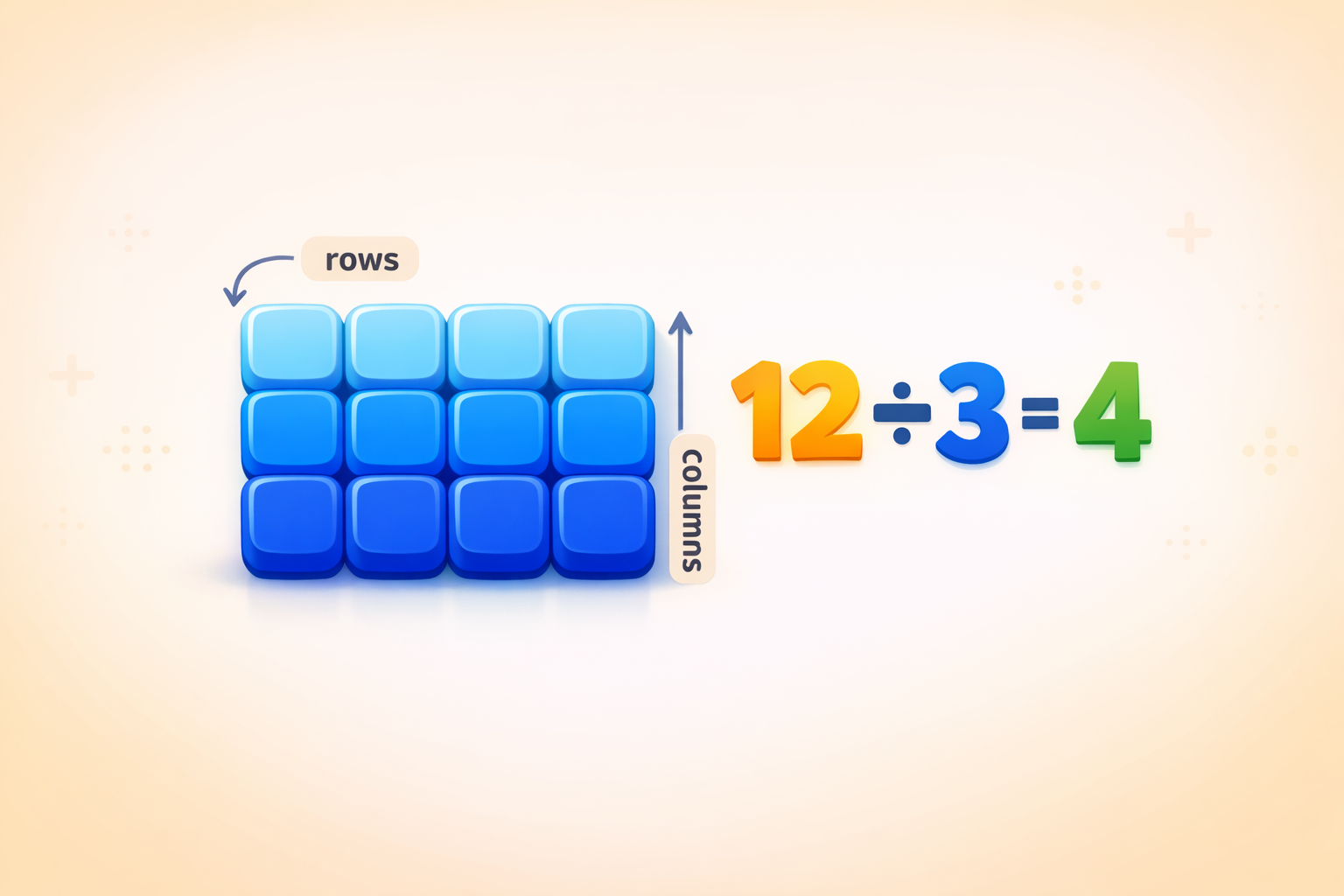
A division sentence is an equation like 12 ÷ 3 = 4. You match the numbers to the picture: total ÷ number of groups = number in each group (or total ÷ number in each group = number of groups).
1 video4 min
4
Write division sentences from arrays
Arrays are made of rows and columns. You can write division sentences from an array by using the total and one side (rows or columns) to find the other side.
2 videos8 min
5
Multiplication and division sentences for arrays
One array can show multiplication and division. For example, a 3 by 4 array shows 3 × 4 = 12, 4 × 3 = 12, 12 ÷ 3 = 4, and 12 ÷ 4 = 3.
1 video4 min
6
Find missing factors using arrays
Division can be an “unknown factor” problem. Example: 32 ÷ 8 means “8 × ? = 32.” You can use arrays and known facts (2–5 and 10, then up to 10) to find the missing number.
3 videos16 min
7
Division facts and story problems
Practice division facts for 2, 3, 4, 5, and 10 (no remainders). Solve story problems by deciding: Are we finding the number of groups, or the number in each group?
2 videos10 min
Start Learning
Begin your learning journey
Modules7
Duration57 min
Science-backed learning
In-video quizzes and scaffolded content to maximize retention.
Key concepts
Division As Making Equal Groups (Fair Sharing And Grouping)Using Arrays With Rows And Columns To Model GroupsWriting Division Equations From Pictures And Stories