Loading course…
Production Realtime Voice Agents, End-to-End
Created by Shaunak Ghosh
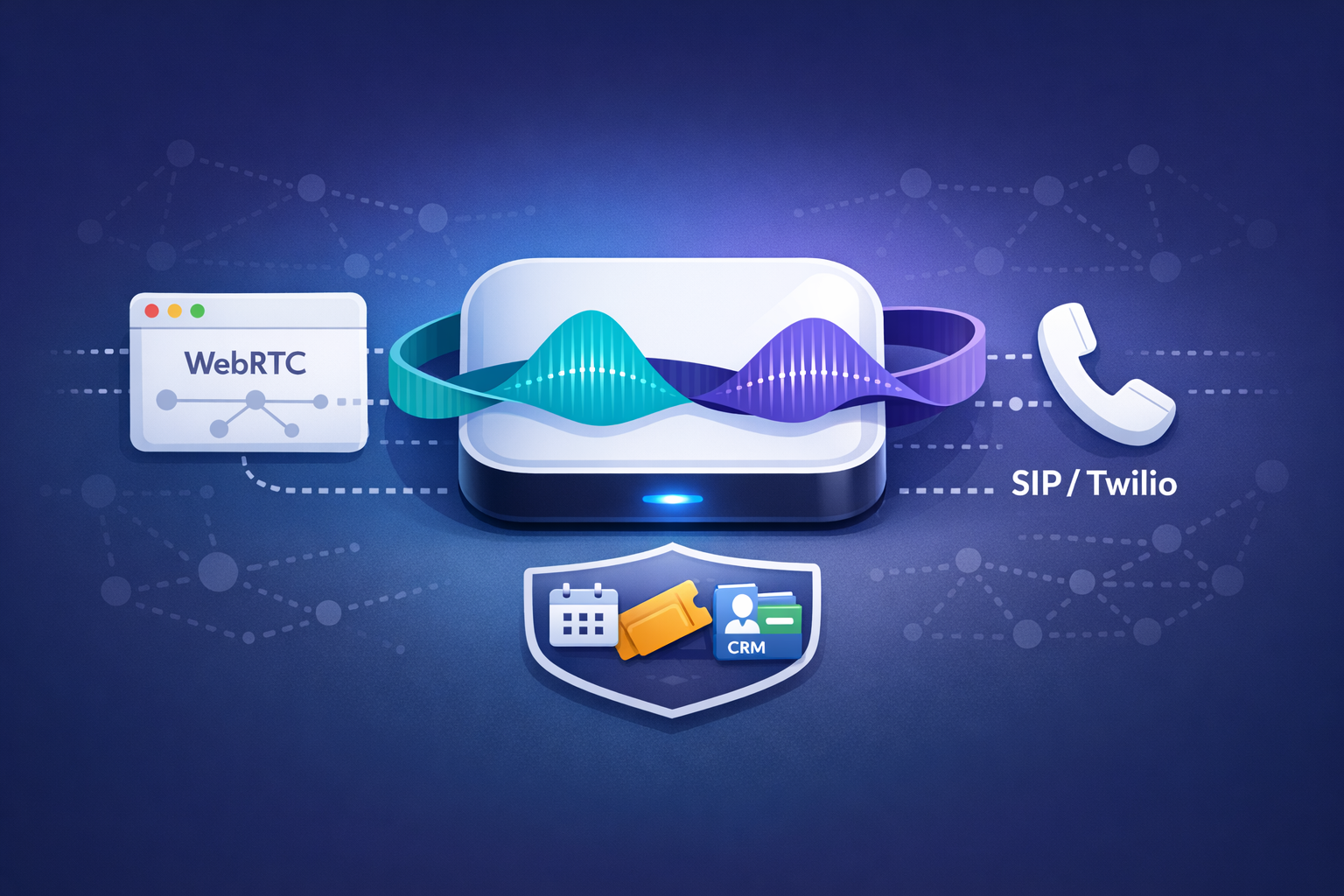
Build a realtime voice agent that feels fast and interruptible, runs in the browser, safely calls action tools via MCP, and extends to phone calls via SIP and Twilio-style flows. You’ll learn the key protocol mechanics, safety boundaries, and the production observability patterns needed to operate it reliably.
Requirements
- HTTP and client–server fundamentals
- Basic JavaScript and/or Python service debugging
- High-level familiarity with STT/LLM/TTS roles
- Comfort reading JSON and API payloads
What you'll learn
- Define and apply an end-to-end latency budget for realtime voice, including what must be streamed versus request–response.
- Explain what WebRTC negotiates during setup, why signaling exists, and how NAT traversal impacts reliability.
- Design a production-grade browser voice gateway that avoids state fragmentation via keep-alives, reconnection, and a single source of truth.
Learning path
8 modules • Each builds on the previous one
1
Full-duplex streaming and latency budgets
Define an end-to-end latency budget for realtime voice and map it onto full-duplex audio streaming, buffering, jitter tolerance, and backpressure so the agent feels fast and interruptible.
1 video6 min
2
WebRTC SDP offer/answer negotiation
Learn how SDP exchange negotiates codecs, encryption, and transport parameters, and how ICE and DTLS-SRTP complete a secure media path between browser and server.
1 video6 min
3
Browser WebRTC voice agent gateway
Design the browser-to-agent gateway: where media terminates, how events flow (tracks, data channels, or side channels), and how reconnection and session state are handled reliably.
1 video8 min
4
MCP tool-calling foundations for actions
Use MCP as a standardized, discoverable tool interface so the agent can call external systems (calendar, tickets, CRM) with consistent schemas, auth, and error handling.
1 video7 min
5
Voice-safe tool execution guardrails
Prevent unsafe or incorrect actions by enforcing least privilege, parameter validation, confirmations, and human-in-the-loop escalation tailored to voice ambiguity and interruptions.
1 video7 min
6
Conversation UX for realtime voice
Design turn-taking, interruption handling, confirmations, and status feedback so the agent feels natural while remaining predictable under latency, tool waits, and partial information.
1 video9 min
7
SIP and PSTN via Twilio
Extend the agent from browser to phone calls by understanding SIP call control, RTP media handling, PSTN constraints, and Twilio-style integration points for routing and media bridging.
2 videos13 min
8
Observability and ops for realtime voice
Instrument media, model, and tool paths with metrics, logs, and traces; define SLOs and runbooks for packet loss, latency regressions, tool failures, and provider outages.
1 video8 min
Start Learning
Begin your learning journey
Modules8
Duration59 min
Science-backed learning
In-video quizzes and scaffolded content to maximize retention.
Key concepts
Latency Budgets For Natural Voice ResponsivenessWebRTC Negotiation, Signaling, And NAT TraversalProduction WebRTC Gateway State And Reconnection