Loading course…
Build Reliable Local-First AI Agents
Created by Shaunak Ghosh
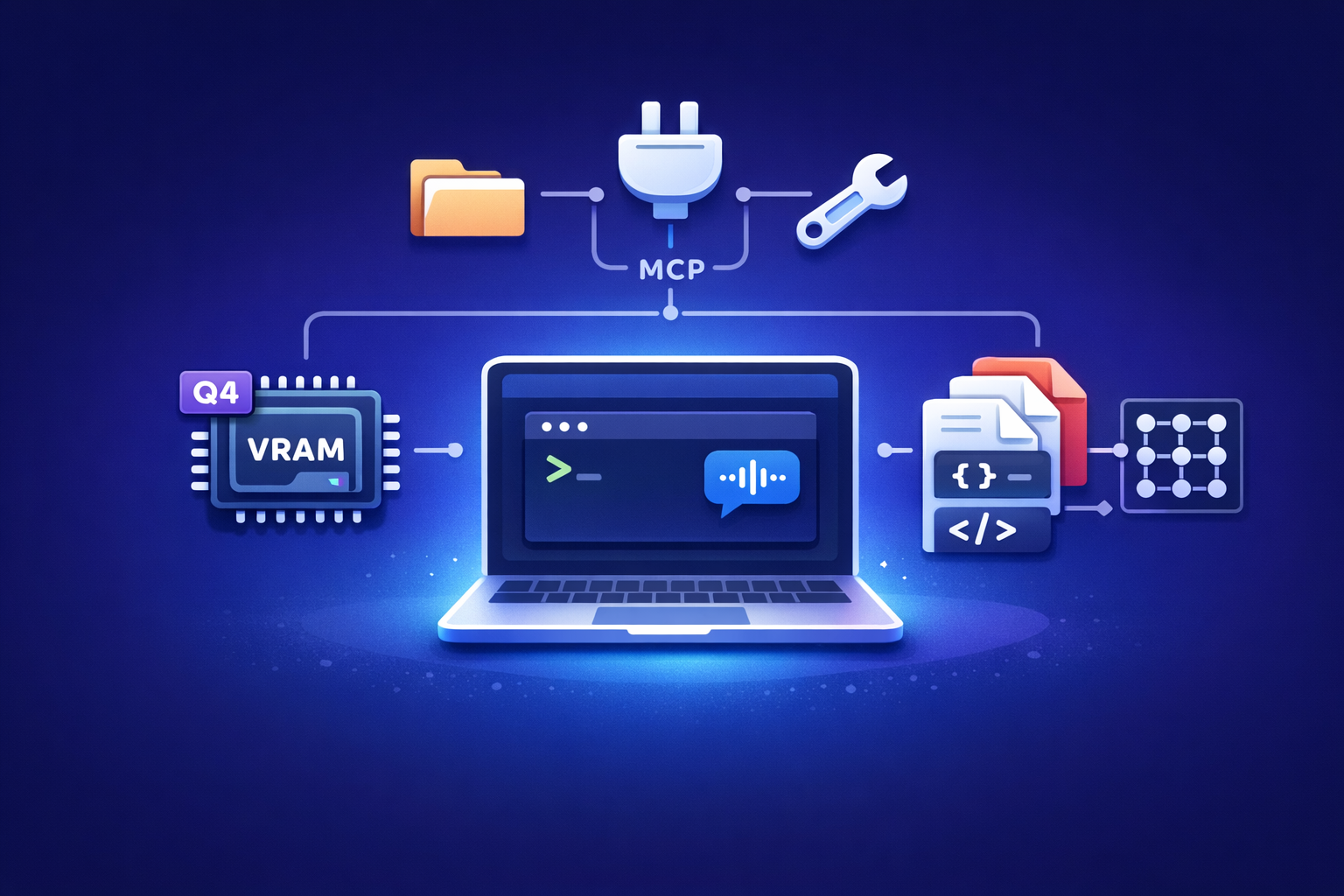
Run high-quality local LLMs with realistic hardware expectations, then build a private RAG workflow over your own documents with grounding and citations. You’ll add operational hygiene for incremental indexing, evaluate RAG quality with the right metrics, and connect your local-first agent to MCP tools with least-privilege defaults.
Requirements
- Comfort with command line basics (install/run local tools)
- Working knowledge of GPUs/VRAM vs RAM at a conceptual level
- Basic Python or scripting literacy (reading configs, IDs, simple code)
- Familiarity with HTTP/API endpoints (localhost services)
What you'll learn
- Estimate feasible local model sizes and context lengths from hardware constraints, including quantization tradeoffs.
- Stand up a repeatable local model workflow and expose a stable local serving endpoint for downstream tools.
- Benchmark local inference beyond single prompts, including concurrency bottlenecks and mitigation strategies.
Learning path
7 modules • Each builds on the previous one
1
Local LLM reality check and constraints
Map latency, throughput, context length, and quality expectations to your actual CPU/GPU, VRAM/RAM, and storage constraints, including how quantization affects speed and accuracy.
1 video10 min
2
Ollama vs LM Studio workflows
Compare setup friction, UX, model lifecycle management, and update strategies across Ollama- and LM Studio-style toolchains to maximize “works on my machine” reliability.
1 video6 min
3
Task-based model selection and benchmarking
Select local models by task category (reasoning, writing, code, small-footprint) using lightweight benchmarks and real prompts, balancing quality, speed, and context needs.
1 video5 min
4
Private RAG pipeline: chunking to retrieval
Design a local-first RAG pipeline that covers document parsing, chunking strategy, embeddings, indexing, and retrieval, with privacy-preserving defaults.
1 video7 min
5
Personal knowledge base ingestion patterns
Apply repeatable patterns for building a local personal knowledge base from notes, PDFs, project folders, meeting transcripts, email exports, and codebases with minimal manual curation.
1 video6 min
6
Grounding checks, citations, and evaluation
Verify RAG answers with citation/grounding checks, measure retrieval quality with targeted tests, and reduce hallucinations through disciplined prompting and evaluation loops.
1 video8 min
7
MCP integration with secure local agents
Integrate a local-first agent with MCP tools using least-privilege design, read-only defaults, and strict directory scoping so automation remains private and predictable.
1 video6 min
Start Learning
Begin your learning journey
Modules7
Duration45 min
Science-backed learning
In-video quizzes and scaffolded content to maximize retention.
Key concepts
Local LLM Hardware Constraints And Quantization TradeoffsRepeatable Local Model Runtime Workflows (LM Studio-Style Serving)Performance Benchmarking For Latency And Concurrency