Loading course…
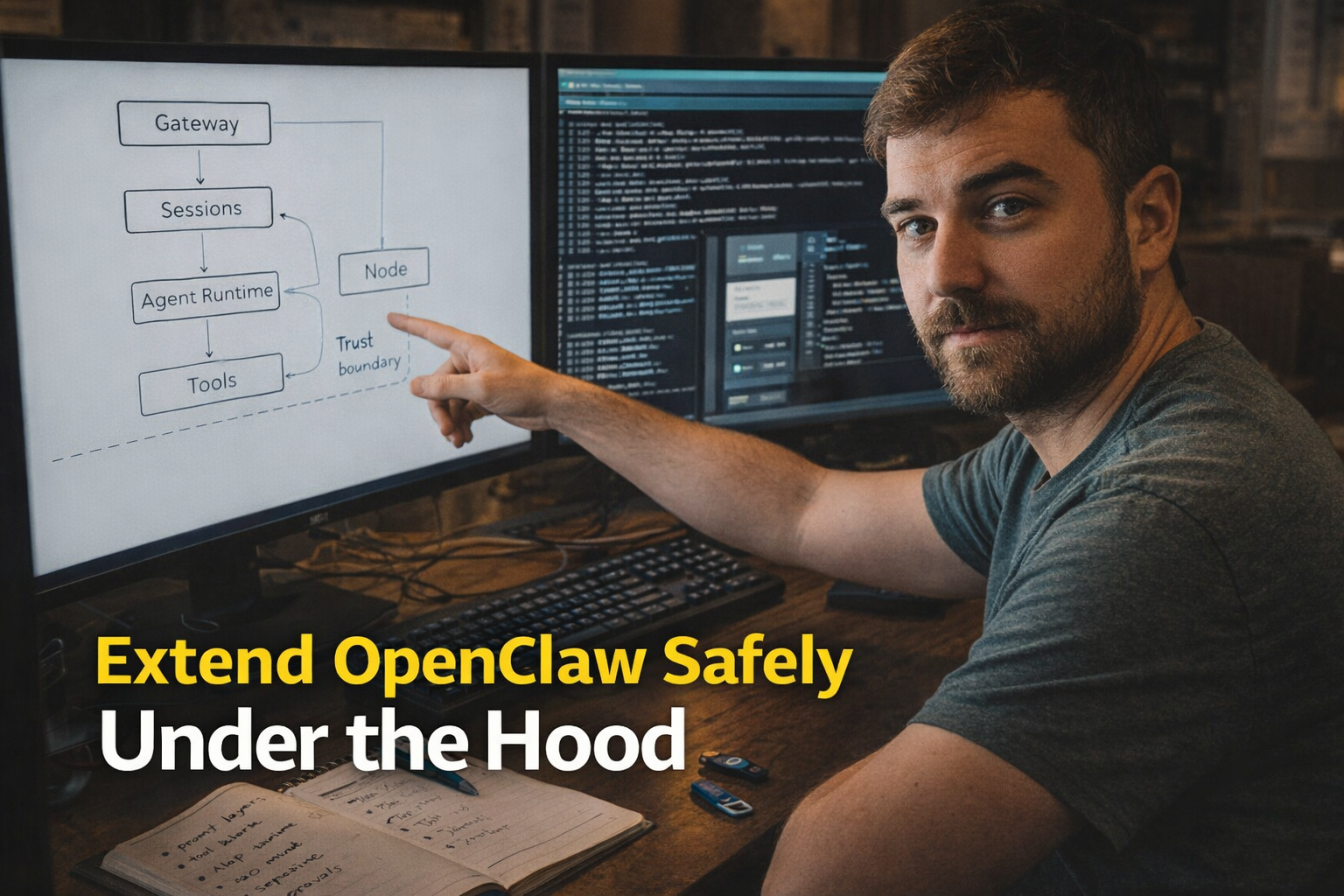
Extend OpenClaw Safely Under the Hood
Created by Shaunak Ghosh
Build an under-the-hood mental model of OpenClaw’s control plane, prompt/tool execution loop, and extension surfaces so you can add capabilities without collapsing trust boundaries. You’ll learn when to use SKILL.md vs plugins/hooks vs MCP-style bridges, and how to enforce sandboxing, tool policy, approvals, and observability in real deployments.
Requirements
- Comfort with event-driven systems (HTTP/WebSockets, adapters, routing)
- Working knowledge of LLM tool/function calling (schemas, tool results, iterative loops)
- Security fundamentals: least privilege, network exposure, supply-chain risk
- Ability to read/edit Markdown/YAML-like config and interpret logs
What you'll learn
- Trace message flow from channel adapter to gateway session routing, through the LLM tool-call loop to side-effecting execution.
- Predict when a tool is callable based on prompt injection, skill loading, and structured tool exposure, and budget context costs accordingly.
- Author SKILL.md-style instructions that are concise, tool-oriented, and verifiable, and choose when to enforce behavior via plugins/hooks instead.
Learning path
7 modules • Each builds on the previous one
1
OpenClaw Gateway and Node Architecture
Build a precise mental model of the Gateway as the long-lived control plane that owns channel sessions, and nodes as capability-advertising devices that execute privileged actions under pairing and policy boundaries.
1 video6 min
2
OpenClaw System Prompt Internals
Understand how OpenClaw assembles a compact system prompt (tools, safety, workspace, skills list) and why tool availability is determined by both prompt text and structured tool schemas sent to the model.
1 video6 min
3
OpenClaw Tool Orchestration Patterns
Learn the reliable “status → snapshot/describe → act → verify” patterns for browser, canvas, cron, and node-targeted tools, with emphasis on minimizing irreversible actions and improving determinism.
1 video6 min
4
OpenClaw SKILL.md Authoring Internals
Master how SKILL.md metadata and instructions shape agent behavior, including how to write concise, tool-oriented procedures that avoid ambiguity and reduce prompt-injection surface area.
1 video7 min
5
OpenClaw Plugin Extension Architecture
Understand plugins as in-process Gateway extensions that can register tools, RPC, commands, and bundled skills, and learn the decision framework for when a capability belongs in a skill, plugin, or external tool bridge.
1 video7 min
6
OpenClaw Sandboxing and Exec Approvals
Learn how sandboxing, tool allow/deny policy, and exec approvals combine into hard enforcement layers that bound blast radius even when the model is confused, tricked, or maliciously prompted.
1 video6 min
7
OpenClaw Debugging and Operational Hardening
Develop a production-grade debugging loop using diagnostics (doctor), logging levels, and targeted status probes to isolate failures in gateway runtime, channels, skills eligibility, nodes, and sandbox policy.
1 video6 min
Start Learning
Begin your learning journey
Modules7
Duration39 min
Science-backed learning
In-video quizzes and scaffolded content to maximize retention.
Key concepts
Gateway Control-Plane Routing And Session IsolationTrust Boundaries: Auth Modes, Pairing Concepts, And Ingress ControlSystem Prompt Layering And Tool Exposure Mechanics