Loading course…
Hardening OpenClaw Agents Against Injection
Created by Shaunak Ghosh
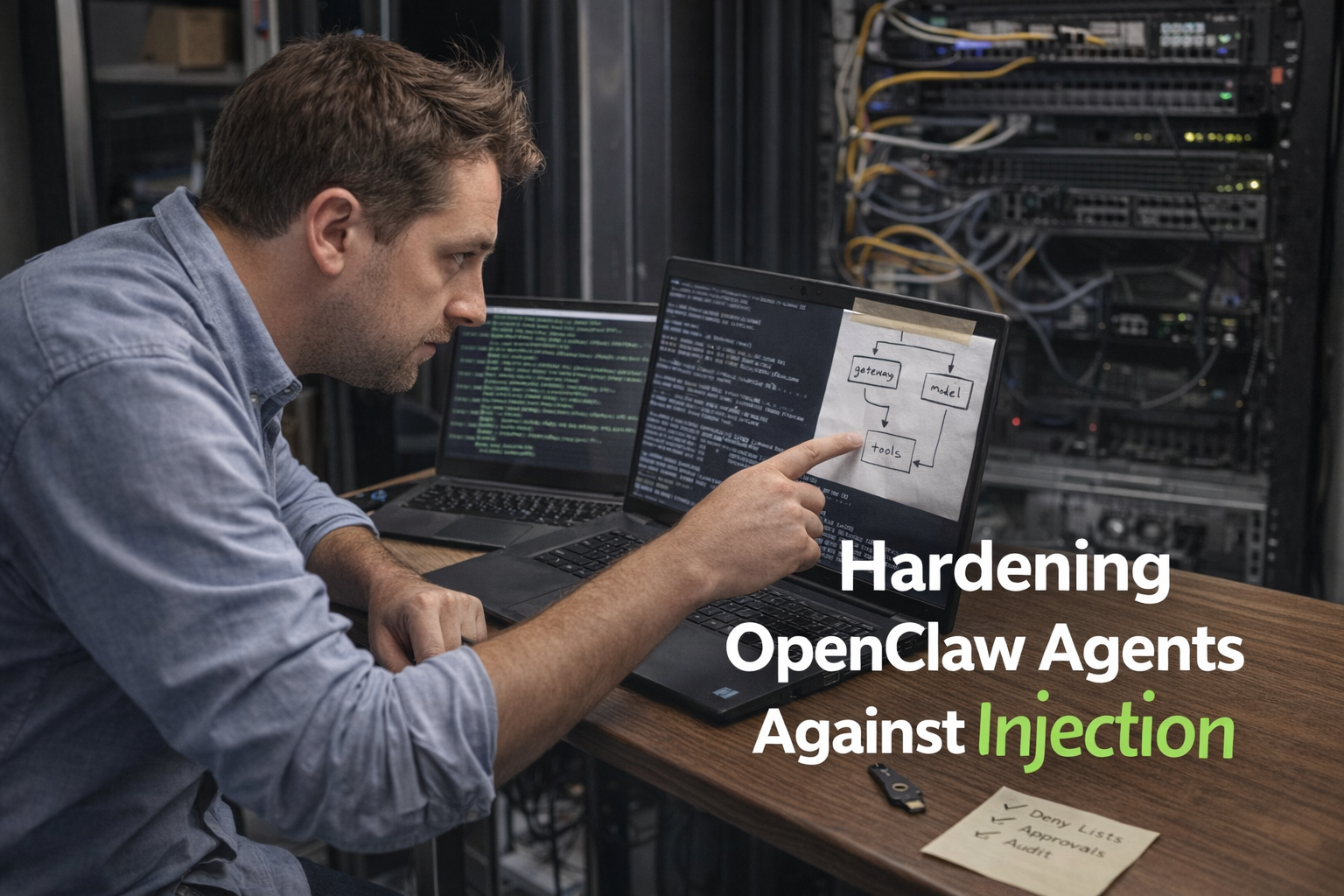
Map OpenClaw’s trust boundaries, then trace how indirect prompt injection turns untrusted email/web content into tool actions. You’ll identify sandbox bypass and host-equivalent execution paths, apply deny lists and elevated approvals, and close the loop by running OpenClaw’s security audit to catch drift before attackers do.
Requirements
- Comfort with tool-calling agents and autonomous loops
- Working knowledge of Docker-style isolation and its limits
- Practical threat modeling and least-privilege thinking
- Production ops basics: logs, health checks, and config drift
What you'll learn
- Produce an explicit, auditable trust-boundary diagram for an always-on OpenClaw agent, distinguishing gateway, model, and tool execution surfaces.
- Explain indirect prompt-injection kill chains where attacker-controlled email/web content becomes tool actions, and why ‘trusted sender’ assumptions don’t solve it.
- Identify concrete sandbox failure and host-equivalent paths in OpenClaw (including elevated exec), and specify what must be fail-closed.
Learning path
4 modules • Each builds on the previous one
1
OpenClaw trust boundaries and tools
Map where OpenClaw receives untrusted content, where the model runs, and where tools execute across the gateway host, sandbox containers, and paired nodes. Use this map to classify which capabilities must be treated as operator-level authority versus safe read-only behavior.
1 video7 min
2
Indirect prompt injection hijack paths
Analyze how a malicious email or webpage can smuggle instructions that override the agent’s goals and trigger tool calls. Focus on why “trusted sender” controls don’t help when the agent reads attacker-controlled content through browsing, fetch, attachments, or pasted text.
1 video6 min
3
Sandbox fallbacks and escape hatches
Identify the specific configurations and runtime paths that make an agent act on the host even when you believe it is sandboxed, including main-session host execution, elevated exec, host-control options, and node-local execution defaults. Learn how to verify the effective execution environment and design for fail-closed behavior when isolation is missing.
2 videos13 min
4
Layered defenses plus security audit
Design a defense-in-depth posture so a hijacked agent cannot cause real damage using channel allowlists, tool deny lists, exec approvals, and constrained execution surfaces. Apply OpenClaw’s security audit and prompt-injection test workflows to catch policy drift and close gaps before attackers do.
1 video6 min
Start Learning
Begin your learning journey
Modules4
Duration30 min
Science-backed learning
In-video quizzes and scaffolded content to maximize retention.
Key concepts
OpenClaw Execution Surfaces And Trust Boundaries (Gateway, Channels, Tools)Operator-Level Authority And Blast-Radius Thinking For Always-On AgentsIndirect Prompt Injection Kill Chains From Email/Web Content