Why Highlighting and Re-Reading Don't Actually Work
Quick experiment. Don't skip this.
Read this list once, then scroll past it: elephant, piano, coffee, notebook, bicycle, lamp, guitar, umbrella.
Got it? Good. Now — without scrolling back up — try to write down all eight words.
Seriously. Pause for a second and try.
Most people get four or five. Maybe six if you're having a sharp day. The thing is, thirty seconds ago, you just read them. They were right there. You saw every single word. And yet your brain already let half of them go.
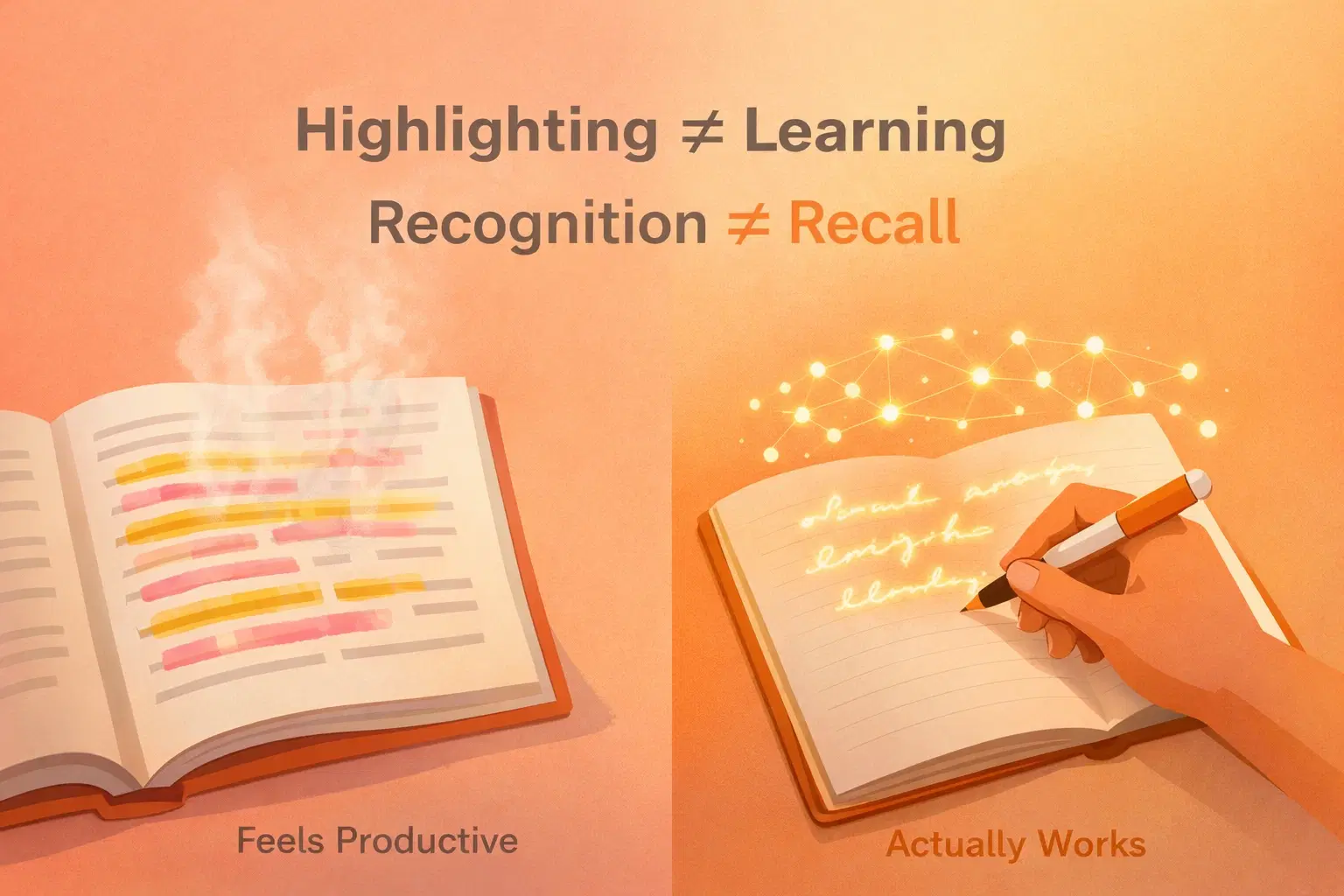
That gap — between what you saw and what you can actually retrieve — is the whole problem. It's exactly what happens every time you highlight a textbook or re-read your notes. The information feels familiar. You walk away confident.
But familiar isn't the same as learned.
What "Fluency" Actually Is
Psychologists call it the illusion of fluency.
When you re-read something, your brain processes it faster the second time. Everything feels smoother. Clearer. Your internal monologue goes, "Yep, I know this." But that's not understanding — it's recognition. Your brain is just pattern-matching on words it's seen before and mistaking that familiarity for knowledge.
Recognition vs. Recall
Recognition is easy: "Do I know this?" feels obvious when you're staring at it. Recall is hard: "What do I know about X?" with a blank page in front of you. Exams, job interviews, real life — they all test recall. But highlighting and re-reading only train recognition.
This is why you can spend three hours "studying" and then bomb the test. You weren't studying. You were building a false sense of confidence.
The Numbers Are Rough
In 2013, John Dunlosky and a team of researchers at Kent State published a massive review — they looked at decades of studies on ten common learning techniques. They rated each one on effectiveness.
Here's what they found:
Rated "Low Utility"
Most popular among students
- Highlighting / underlining
- Re-reading
- Summarization
- Keyword mnemonics
- Imagery for text
Rated "High Utility"
Rarely used by students
- Practice testing (self-quizzing)
- Distributed practice (spacing)
Five techniques rated low. Only two rated high. And the irony? The low-utility techniques are the ones everyone uses. Highlighters are a billion-dollar industry. Re-reading is the default study method for most students on the planet.
Meanwhile, the two techniques that actually work — testing yourself and spacing out your sessions — feel unnatural and uncomfortable. So most people avoid them.
What Happens When You Highlight
Highlighting feels productive. Your hand is moving. Colors on the page. You're deciding what's important. Except — that's all you're doing. Sorting. "Important" or "not important." You're not asking why it matters or connecting it to anything you already know.
Nist & Holschuh tested this in 2005. Students who highlighted performed no better on comprehension tests than students who just read without marking anything. Some highlighters actually did worse — they burned mental energy deciding what to mark instead of processing the content.
The deeper problem
Highlighting gives you a false bookmark. You look at a highlighted page and think, "I'll come back to this later and it'll be efficient." But when "later" comes, you re-read the highlights — which is just re-reading with extra steps. The illusion compounds.
Why Re-Reading Is Even Sneakier
Re-reading is trickier, because the second read genuinely feels different. First time: slow, confusing, effortful. Second time: smooth, clear, easy. Your brain goes, "See? I get it now."
Nope. Your eyes just got faster at parsing the words. Your short-term memory recognized the sentence structure. None of that means the ideas moved into long-term memory. It's like hearing a song in a foreign language twice and thinking you speak the language because the melody sounds familiar.
From the research
~5%
Callender & McDaniel (2009) found that a second reading of a text passage improved recall by only about 5% compared to a single reading — a negligible gain for double the time invested.
Five percent. For twice the time. That's what re-reading buys you.
So What Actually Works?
Roediger and Karpicke ran a study in 2006: students who read material once and then practiced retrieving it from memory remembered 50% more after one week than students who re-read the same material four times. Retrieval beats repetition, every time.
Here's what that looks like in practice:
A Better Study Session
Read it once. No highlighter.
Just read. Slow down at the hard parts. That's fine — friction means your brain is working.
Close the book. Write what you remember.
Everyone skips this step. It's the one that matters most. Blank sheet. No peeking. You'll forget things — that's the point.
Check yourself.
Open the book. Compare. The things you missed are your actual blind spots — now you know where to focus.
Ask "why" and "how."
Don't just memorize facts. Ask why they're true. How they connect to stuff you already know. That questioning is what pushes ideas deeper.
Come back later.
Try recalling the same material tomorrow. Then in three days. Then a week. Each time you successfully pull it from memory, it sticks a little more.
Fair warning: this will feel awful compared to highlighting. You'll close the book, try to recall, and your mind will go blank. That's not failure — that's your brain actually working. The struggle is the learning.
The Bigger Picture
This goes way beyond exam prep. You watch a coding tutorial and nod along — then can't write a single line on your own. You read a recipe three times — then stand in the kitchen blank. You sit through a meeting — then can't name the key decisions an hour later.
Same trap every time. The fix is the same too: close the tutorial and try building it. Put the recipe down and cook from memory. After the meeting, write down what was decided without checking your notes. You'll mess up. That's the point.
One Last Thing
Remember those eight words from the start? Try recalling them again. Don't scroll up.
If you got more this time — even one or two extra — that's because you tried retrieving them earlier. That one awkward attempt, where you forgot half, actually made the memory stronger.
That's the whole thing. Not better highlighters. Not reading it one more time. Just the willingness to close the book and see what stuck.
Stop Highlighting. Start Retrieving.
LearnLens Studio builds active recall directly into your learning. No highlighting. No re-reading. Just retrieval practice, spaced repetition, and evidence-based strategies that actually move knowledge into long-term memory.
Try LearnLens Studio