Why Everything You Know About 'Watching to Learn' is Wrong
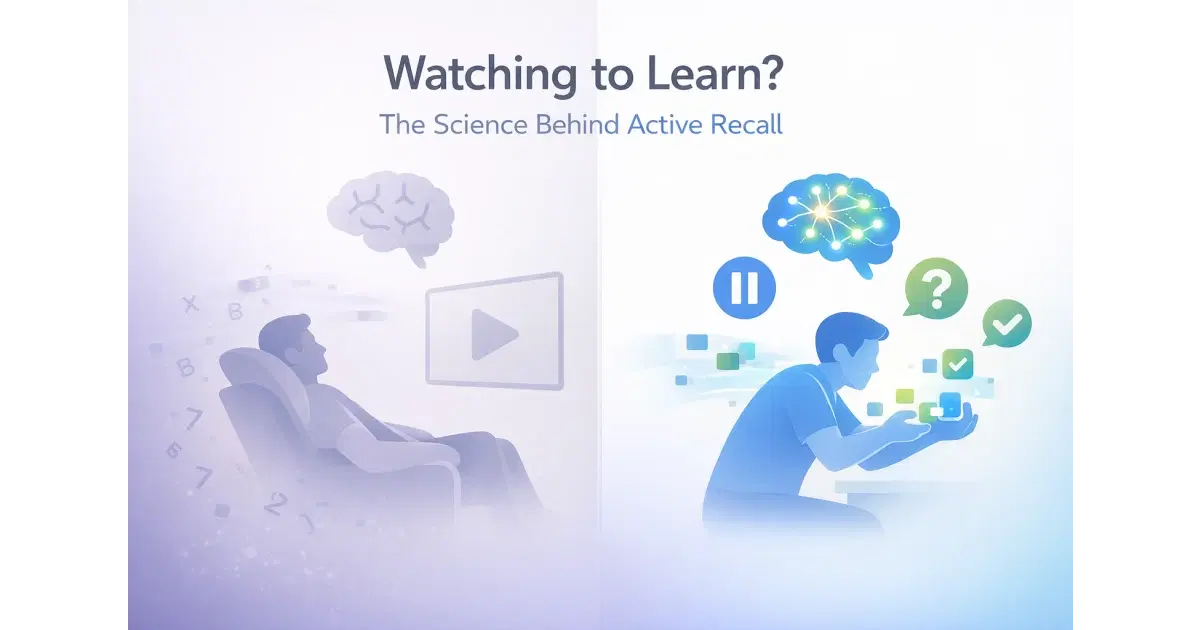
You've done it before. I know I have.
You watch a 45-minute YouTube tutorial. The instructor is clear. Everything makes sense. You nod along. "Yeah, I get it." You even take a few notes. You close the video feeling good. Productive, even.
Two days later, you sit down to actually do the thing. And... nothing. Your mind is blank. You remember the instructor's face. Maybe a few words. But the actual knowledge? Gone.
What happened?
The answer reveals a fundamental flaw in how most of us try to learn from videos.
The Watching Trap
Here's the uncomfortable truth: watching a video about something is not the same as learning it.
It's like:
- • Watching Gordon Ramsay cook and thinking you can now make beef Wellington
- • Watching someone solve a Rubik's Cube and believing you could do it yourself
- • Reading a recipe and expecting to be a chef
But why does it feel like we're learning when we watch?
The Illusion of Competence
When information flows smoothly from instructor to our ears, our brain interprets that fluency as understanding. Psychologists call this the "illusion of competence." We mistake familiarity for mastery.
What Your Brain is Actually Doing
When you watch a video, your brain is in recognition mode, not recall mode.
Recognition Mode
"Oh yeah, I've seen this before."
- • Passive
- • Low effort
- • No memory retrieval
- • Feels easy = weak learning
Recall Mode
"Let me pull this from memory..."
- • Active
- • Requires effort
- • Forces retrieval
- • Feels hard = strong learning
Think about it: When was the last time you actually learned something? Not just watched or read about it—but truly learned it so you could use it later?
Chances are, you had to do something. Practice. Answer questions. Explain it to someone. Make mistakes. Try again.
The Science: The Testing Effect
In 2006, psychologists Roediger and Karpicke ran a study that should have changed education forever.
They had students learn material in two ways:
The Re-readers
Read the material four times
The Retrievers
Read it once, then took three practice tests (without looking)
One week later, they tested both groups.
The Result
+50%
Group 2—the students who practiced retrieving information—remembered 50% more than the group that just re-read the material.
Not 5% more. Not 10% more. Fifty percent.
The Takeaway
Active retrieval—the act of pulling information from memory—is what creates lasting learning. Not passive exposure.
So What Actually Works?
The Mindset Shift
Stop treating videos as something to "get through." Start treating them as raw material for active practice.
What to Do Instead:
Pause and predict
Before the instructor explains something, pause. Ask yourself: "What do I think will happen next?" or "How would I solve this?"
Close and recall
Every 5-10 minutes, pause the video. Close your eyes. Try to explain what you just learned to an imaginary friend. Out loud.
Answer questions during, not after
If someone asks you a quiz question after a video, it's a test. If they ask during? That's when your brain is forced to retrieve while the context is fresh. That's the magic moment.
Struggle with it
If retrieval feels easy, you're not learning much. The effort—the struggle to remember—is what strengthens the memory. Embrace the difficulty.
The Uncomfortable Truth
Passive watching feels good. It's comfortable. You can lean back, relax, and let the information wash over you.
Active learning feels... annoying. It's harder. You have to pause. Think. Struggle. Second-guess yourself.
But here's the thing: Easy studying creates the illusion of learning. Hard studying creates actual learning.
Your brain is lazy. It wants to conserve energy. And it's very good at tricking you into thinking you've learned something when you haven't.
The only way to beat this? Force your brain to work. Make it retrieve. Make it struggle.
What This Means for You
Next time you sit down to "learn" from a video, ask yourself: Am I watching, or am I learning?
If you're just pressing play and nodding along, you're wasting your time. You'll finish feeling accomplished but remember almost nothing.
But if you pause, predict, recall, and test yourself? You'll finish feeling uncertain—maybe even a bit frustrated. And that's exactly when real learning happens.
That discomfort is your brain rewiring itself. That's growth.
So stop watching to learn. Start learning while you watch.
Want to Learn the Right Way?
LearnLens Studio builds active recall right into your videos. Pause automatically. Questions at the right moments. Track what actually sticks.
Try LearnLens Studio